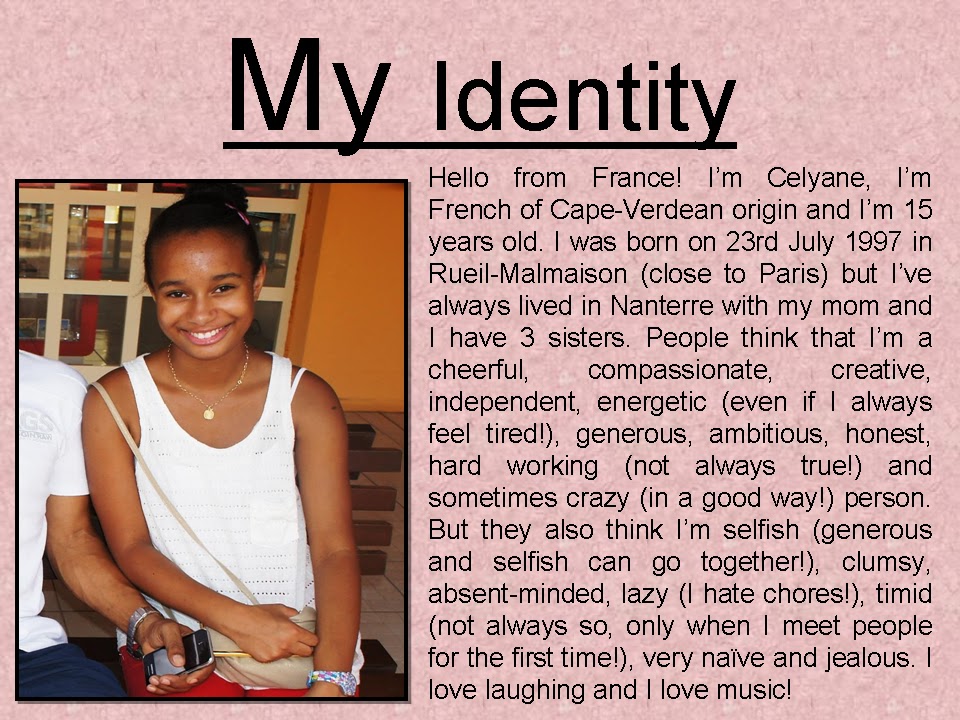
Hello all,
Célyane has written an article on high school life in France for you. She tells about the French curriculum, the different choices for a major, the national "bac" diploma (or high school final exam), graduation, a typical school timetable, our holiday breaks, our holidays, our school dress code...
Enjoy!
High School Life
→The national schooling system
•Our curriculum
In France the curriculum is created by the Ministry of
National Education and it is edited almost every year. The main subjects (that
are compulsory) are humanities, civil education, math, sciences (physics +
biology), English, French, PE and a second foreign language (the one we did in
8th and 9th grade, such as Italian, Spanish, German,
Arabic, English or Portuguese). English is compulsory from the 5th
grade (and sometimes even before …We love English here!). In 10th
grade we must study all these fundamental subjects, all year long. We must also
take two classes of “exploration”, which are:
-
Basic principles of economics and management
-
Economics and Social Sciences,
which are compulsory too and we have to choose another
exploration teaching, such as “health & social science”, “sciences &
laboratory”, “literature & society”
or “theater”, or even a third foreign language, for example, if I learn English
and Spanish, I can take Italian as a third foreign language.
We have to choose our exploration teaching when we
register in the high school (at the end of 9th grade) and we start
them only in 10th grade. Not all exploration teachings are available
in high schools so you can choose your high school according to the kind of
exploration teaching you wish to take.
Then we also have individual support. If we have
difficulties in a subject, a teacher will help us for one hour (every week).
•Majors
In 11th and 12th grade, the major changes. At the end
of 10th grade we must choose one curriculum. If our teachers think that we
don’t have the skills to do the curriculum we’d like to, we must choose another
one or flunk (repeat a year).
In the general curriculum, we study several subjects.
The main majors (the general curriculum) are:
- Literary major: French, literature and foreign languages are
our major classes.
- Economics and social science major: we
study almost all subjects (humanities, math, sciences and foreign languages).
- Scientific major: sciences and math are the major classes.
But if you are, for example, in a scientific major, it
doesn’t mean that you will not have to study humanities, you still have to
learn it but you will have less hours than for math.
Technological majors are majors where we study
something that deals with vocational studies, like health or management for
example.
The technological curricula are: (yes there are lots
of sciences!)
- Industry
and Sustainable Development Science and Technology,
- Design
and Visual Arts Science and Technology,
- Laboratory
Science and Technology
- Health
and Social Science and Technology
- Management
Science and technology
- Agronomy
and Life Science and Technology
- Music
and Dance Techniques
- Hotel
Trade and Business
•High school diploma
We take the high school diploma at the end of 12th
grade, except for French that we take at the end of 11th grade (We don’t have
French in 12th grade even for the ones who are in literary major but it counts
for the final grade of the baccalauréat r bac – that is the equivalent to your
SATs). We take English, philosophy (only in 12th grade), math,
humanities & civil education, biology, physics and PE. When the exam is
finished (at the end of June) we have to wait until early July to know the
results. If you pass, you can start your higher studies in September, but if
you don’t, there are two solutions:
- If
you fail by a few points, you can take a catch-up oral exam
- But
if you fail by too many points and there is no alternative, you either choose
to repeat a year or to stop school (we can stop school at the age of 16 years
old).
•Graduation
When we get our diploma, the city hall organizes a
ceremony. All the new graduates are invited and they receive their diploma. But
this ceremony takes place in early October of the same year and we don’t have a
graduation ceremony in the school like you do at the end of the school year. We
don’t even have Prom night, can you believe it?
•Our timetable
In France, we usually have 3 hours of humanities, 4
hours of French, 4 hours of math, 3 hours of English, 2 hours of a second
foreign language, one hour and half of biology, 3 hours and half of physics,
one hour of basic principles of economics and management (every two weeks), one
hour of economics and Social Sciences (every two weeks), 3 hours of exploration
teaching, one hour of individual support and one hour of civil education (every
two weeks). We have 27 hours of class a week.
Our schedule is very heavy. We usually start at 8 am
and we usually finish at 5:30 pm except on Wednesdays when we usually finish at
12:30 am. Some students may have school in the afternoon. Some students may
have school on Saturday mornings too. (We hate having school on Wednesday
afternoons or Saturday mornings!)
But this may change!
For example: On Thursday, Melissa starts at 9 am and
she finishes at 1:30 pm, then she has a é-hour lunch break (we don’t have to
eat at the cafeteria, if we have time to go back home, we can!) and she comes
back to school at 3:30 pm and she finishes school at 4:30 pm.
Another example: On Monday, I start at 8 am and I
finish at 12:30 pm, then I come back to school at 1:30 pm (I have one hour for
lunch break) and I finish school at 3:30 pm but Melissa finishes at 5:30 pm.
The timetables are different every day and every class
has a different timetable.
And if we know that a teacher will be missing the
following day, our schedule can also change.
For example: On my timetable, on Fridays, I start at 8
am with Spanish class, but I know that
she won’t be there tomorrow, so I’ll start at 9 am.
Or: Usually on Tuesdays Stephen has two hours of
French from 1:30 pm until 3:30 pm, but he was told this morning that the
teacher would be absent! So it means that he won’t have school tomorrow
afternoon.
But if a teacher is absent between two classes, we can
go back home if we have the time, stay outside the high school for one hour,
stay in the school playground or go to the school library. But sometimes, we
can have a free hour between two classes in our timetable.
*Usually when you start at 8 am and finish at 5:30 pm
almost every day and you know that your friend starts at 9 am sometimes or
finishes at 3:30 pm, you get jealous because you hate your heavy schedule.*
• Holidays
breaks
In France we have 5 holiday breaks over the year. We
have a two-week break every six weeks:
-
All Saints break : two weeks (end of October – early
November)
-
Christmas break : two weeks (two days before Christmas
– early January)
-
Winter break : two weeks (early March – mid-March)
-
Easter break : two weeks (end of April – mid-May)
-
Summer break : 2 months (end of June – early
September)
*Holiday breaks are one of the only things we love
about school!*
And we also have several days off:
-
All Saints day (Toussaint) : 1st November
-
Veteran’s Day (Armistice): 11th November
-
Christmas (Noël) : 25th December
-
New year’s day (Jour de l’an): 1st January
-
Easter (Pâques): 31th March
-
Easter Monday (Lundi de pâques): 1st April
-
Labor Day (Fête du travail) : 1st May
-
Victory 1945 (Victoire 1945) : 8th May
-
Ascension Day (Ascension) : 9th May
-
Pentecost (Pentecôte) : 19th May
-
Whit Monday
(Lundi de Pentecôte): 20th May
-
Bastille day (Fête Nationale) : 14th July
-
Assumption (L’Assomption): 15th August
*Our favorite month is May of course …!*
But there are other holidays when we have school:
-
Epiphany (Epiphanie): 6th January (we
usually eat a traditional and very delicious pastry called La Galette des Rois,
or Twelfth Night cake, that contains a hidden lucky charm, and the one that
gets the charm in their piece of cake gets to become King or Queen!)
-
Candlemas (La Chandeleur): 2nd February (we
eat pancakes!)
-
Valentine’s day (La saint Valentin): 14th
February (this holiday is probably international!)
-
Mardi Gras: 21st February (when we dress up
in costumes, it’s a lot of funJ)
-
Grandmother’s day (fête des grand-mères): early March
-
April Fool’s day (Poisson d’avril): April, 1st
(when we play tricks to people, usually with a fish drawing that we try to
stick on our friends’ backs without their noticing!)
-
Mother’s day (fête des mères): end of May-early June
-
Father’s day (fête des pères): mid-June
-
Music’s day (fête de la musique): 21st June (when
every one is allowed to play music in the street and there are concerts every
where, in bars, in the streets, in the park…)
-
Grandfather’s day (fête des grand-pères) : early
October
•Dress code
In France, there isn’t any dress code to attend
school. We go to school as we want (except for inappropriate clothes like mini
skirts or worn out clothes!). Usually, boys wear track suits with sneakers but
lots of boys wear jeans. And girls usually wear casual clothes like skinny
jeans or leggings with boots or sneakers but they don’t like wearing dresses
and skirts. Some girls like to be comfortable so they wear track suits with
sneakers. We usually all dress like this but some people have their own look
but we don’t see them a lot because they are a bit too original.
But in a few schools (that are Private schools),
pupils have to wear uniform.
Célyane